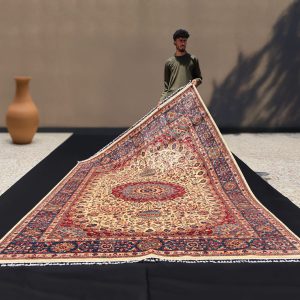
12×17 Red Heriz Rug – Hand-Knotted Afghan Heriz Rug
Commanding in scale and rich in character, this 12×17 red Heriz rug brings the bold geometry of the Heriz tradition to a substantial hand-knotted Afghan carpet. Measuring approximately 12’1″ × 17’5″, the rug features a deep red field framed by navy blue borders, with light blue and ivory accents adding definition and balance throughout the composition.
Three prominent geometric medallions form the centerpiece of the design, surrounded by stylized floral motifs arranged with the strong symmetry and architectural character associated with Heriz rugs. Its generous proportions make it particularly well suited to large living rooms, dining areas, great rooms, and other spaces where the rug can serve as a defining element of the interior.
Key Features
- Size: 369 × 530 cm (approximately 12’1″ × 17’5″)
- Design: Traditional Heriz
- Pattern: Three geometric medallions surrounded by geometric floral motifs
- Colors: Red field, navy blue borders, with light blue and ivory accents
- Construction: Hand-knotted
- Origin: Sheberghan, Afghanistan
Quality
This rug is hand-knotted with a Ghazni handspun wool pile on a cotton foundation, combining the natural character of handspun wool with the structural stability of cotton. Ghazni wool is valued in Afghan rug making for its resilience, texture, and ability to develop an increasingly inviting character with age and use.
With an average density of 82 knots per square inch, the rug offers the durability required for a large-format floor covering while retaining clear definition across its medallions, floral elements, and intricate borders. The slight variations inherent in handspun wool and hand-knotting contribute to the individuality of the piece rather than the uniform appearance of machine-made rugs.
Origin & Tradition
Hand-knotted in Sheberghan, Afghanistan, this rug reflects Afghanistan’s long-established tradition of adapting classical Persian and regional designs through the skills of local weavers. The Heriz design is especially recognizable for its angular geometry, powerful central compositions, and stylized floral ornamentation—a character that distinguishes it from the softer curves found in many classical Persian patterns.
Here, the traditional Heriz vocabulary is interpreted through Afghan craftsmanship, Ghazni handspun wool, and a rich red-and-navy palette. The result is a substantial, individually woven carpet that brings both decorative presence and generations of weaving tradition into the home.